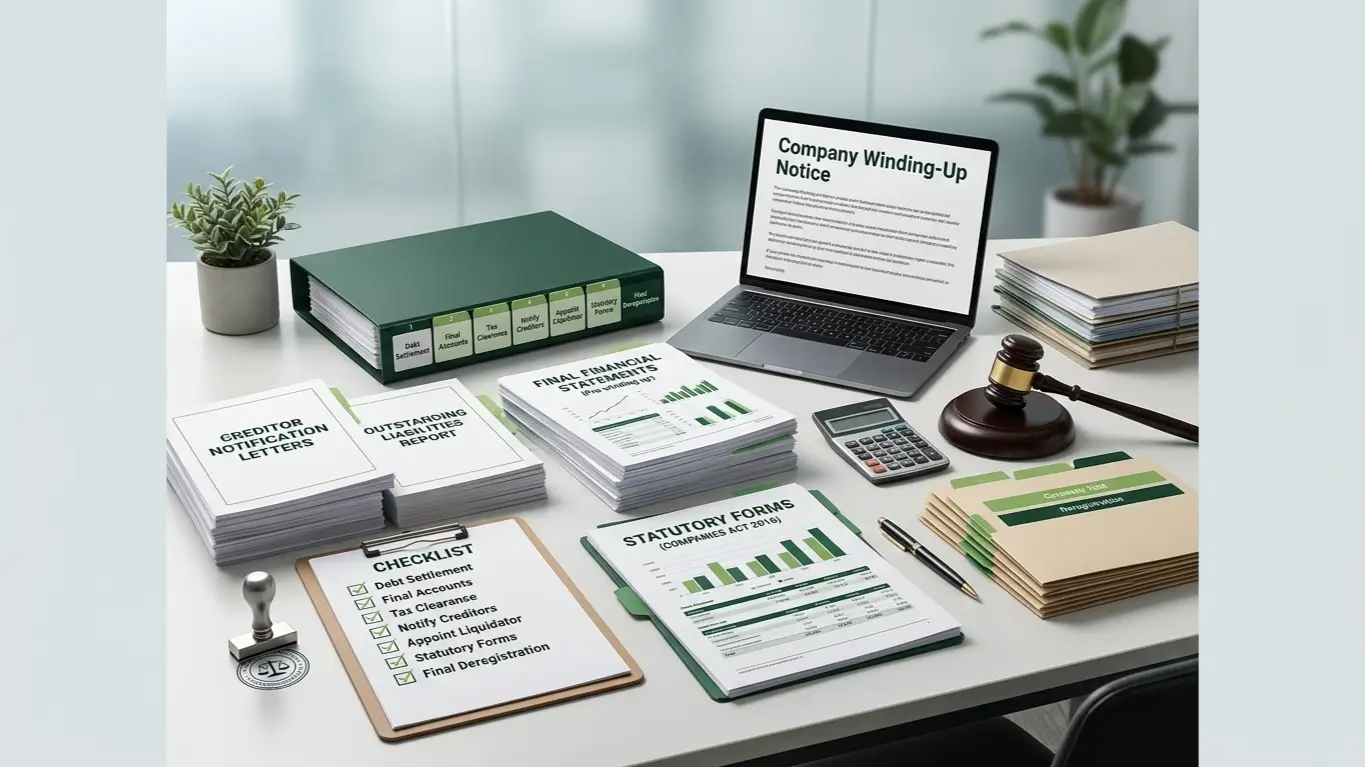
Key Takeaway
Q1: What are the 7 winding up rules every SME should check before closing a company, and why do they matter?
The 7 winding up rules cover the legal framework, winding-up type, solvency, filing procedure, liquidator powers, costs, and final dissolution, all of which affect Companies Act compliance, creditor exposure, and director decision-making in Malaysia.
Q2: How do winding up rules work in practice for Malaysian SMEs?
Winding up rules work by determining whether a company should follow a members’ voluntary winding up, creditors’ voluntary winding up, or court-driven compulsory winding up, with each route requiring different declarations, filings, notices, and liquidation procedures.
Q3: What should a business owner do next before starting a company closure?
A business owner should first review solvency, liabilities, tax exposure, corporate records, and procedural requirements with a qualified company secretary or advisory team before filing any resolution, petition, or liquidation document that could trigger regulatory consequences.
winding up rules are not just technical legal provisions; they shape how an SME in Malaysia exits the market without triggering unnecessary disputes, compliance breaches, or director risk.
For business owners, founders, and management teams, closing a company is rarely as simple as stopping operations, because liabilities, statutory filings, creditor rights, and dissolution procedures still need to be handled correctly.
That is why understanding the difference between voluntary winding up, compulsory winding up, solvency requirements, and liquidation procedure is essential before any resolution is passed.
For SMEs, startups, and companies undergoing restructuring, the real risk is not only the closure itself but the mistakes made before the process begins.
A company may appear inactive, yet still carry unpaid tax exposure, unresolved creditor claims, incomplete statutory records, or director responsibilities under the Companies Act framework.
In practice, the wrong closure route can increase costs, delay dissolution, and create unnecessary scrutiny from regulators, creditors, and other stakeholders.
This is where experienced corporate advisory support becomes valuable.
Firms like Procheck, with more than 25 years of experience in company secretary services, compliance support, tax advisory, and business consulting, help businesses navigate regulated processes with greater clarity and control.
Simplify Your Tax Management Today!
Partner with Procheck today to unlock your business’s full potential. Our team of experts is ready to help you navigate taxation challenges and achieve your strategic goals.
Request a Free Consultation
Get started with a no-obligation consultation to discover how we can transform your financial operations.
That trust is reflected in client feedback such as
“Perkhidmatan Setiausaha Syarikat dari Procheck sangat profesional dan cekap. Mereka membantu saya menguruskan dokumentasi syarikat dengan teliti dan memastikan pematuhan undang-undang.”
Noor Ariffshah’s
For SMEs considering closure, that level of procedural care matters.
In this article, we will break down the 7 winding up rules every SME should check before closing a company, so you can evaluate the right route, reduce legal exposure, and plan a cleaner exit.
What are the main winding up rules Malaysia SMEs must understand first?
Malaysia’s winding-up framework requires SMEs to distinguish between statutory rules, court procedure, insolvency practice, and the practical role of the liquidator before any closure decision is formalised.
How do the companies winding up rules 1972 fit into Malaysia’s winding-up framework?
The companies winding up rules 1972 remain important because they govern procedural and fee-related matters that still affect liquidation administration, especially where the Official Receiver and proof-related charges are involved.
For SMEs, this means the closure process is not only about deciding to shut down. It also involves knowing which filings, searches, inspections, and payment applications may arise, and whether the matter stays internal or becomes a court-driven insolvency event.
The fee tables published by the Malaysia Department of Insolvency show that procedural costs can attach to inspections, searches, special bank accounts, payment applications, and distributions.
Why do older procedures still matter in some winding-up cases?
Older procedures still matter because Malaysian winding-up practice developed through legacy company law and continues to rely on formal process discipline, especially in liquidation, creditor communication, and court-led insolvency matters.
That is why SMEs should not assume an inactive company can simply be abandoned.
Winding up is a regulated exit route, while dissolution is the legal endpoint after the process has been completed.
Confusing these stages can cause directors to underestimate their ongoing obligations.
Which companies winding up rules apply to voluntary and compulsory winding up?
The companies winding up rules apply differently depending on whether the company is solvent, insolvent, internally resolving to close, or being forced into court by a creditor.
What is a voluntary winding up?
A voluntary winding up is a company-led process started by directors and shareholders or members, and it does not begin with a court order.
There are two main forms. A members’ voluntary winding up is used when the company is solvent and can pay its debts in full within the required period.
A creditors’ voluntary winding up is used when the company is insolvent, and creditors gain greater influence, including over the identity of the liquidator.
Members’ voluntary winding up for solvent companies
A solvent company may choose this route when directors have properly reviewed its affairs and are satisfied that debts can be paid in full, typically within twelve months from commencement.
Creditors’ voluntary winding up for insolvent companies
An insolvent company can still initiate closure, but creditor meetings, notices, and creditor involvement become central because recoveries and distributions are now at risk.
What is a compulsory winding up through the court?
A compulsory winding up company is a court-driven process, commonly triggered when a creditor alleges the company is unable to pay its debts and files a winding-up petition.
The practical risk for SMEs is severe. Once a petition is filed and advertised, the matter can become public, affect reputation, alarm contracting parties, and even lead to pressure from banks or counterparties.
When a creditor may start the court process
A creditor typically moves after non-payment and uses the court petition route to seek a winding-up order based on inability to pay debts.
How a winding-up petition changes the company’s position
Once the petition enters the public process, the company is no longer dealing with a private commercial dispute alone; it faces formal insolvency exposure with mandatory publicity implications.
How do the winding up rules 1972 treat solvency before a company can be closed?
The winding up rules 1972 and related practice materials make solvency the critical dividing line between a members’ voluntary winding up and creditor-led outcomes.
Why is solvency the key test for a members’ voluntary winding up?
Solvency matters because a members’ voluntary winding up can only begin where the company can meet its debts in full and has sufficient liquid funds to cover liquidation costs and expenses.
What is a declaration of solvency and why does it matter?
A declaration of solvency is the directors’ formal written confirmation that they have inquired into the company’s affairs and believe it can settle debts within the permitted period.
This is not a casual formality. The guidance note stresses that directors should review books, liabilities, tax implications, and asset realisation issues before the winding-up resolution is passed.
For SMEs, this is where accounting, tax, and Company Secretary Services become commercially important.
What procedural steps under winding up rules malaysia pdf should SMEs expect during closure?
The winding up rules malaysia pdf materials show that closure usually involves pre-appointment checks, internal resolutions, filings, notices, advertisements, and then the liquidator-led administration of assets and claims.
What happens before the winding-up resolution or petition is filed?
Before filing begins, advisers typically review company records, solvency, director exposure, tax position, conflicts of interest, and whether the chosen liquidator is suitable for appointment.
What happens in a voluntary winding up process?
A voluntary process usually moves through a shareholders’ meeting, a special resolution, lodgement with the Registrar, and advertisement requirements within the required timeframe.
Calling the shareholders’ meeting
A general meeting is needed to pass the special resolution to wind up the company voluntarily.
Filing the resolution with the Registrar
The resolution should be lodged with the Registrar within the required timeline and in the prescribed form.
Advertisement requirements after the resolution
Notice of the resolution should be advertised within the required period after the resolution is passed.
What happens in a compulsory winding up process?
A compulsory process typically involves demand, petition filing, service, advertisement, gazette notice, and court hearing before a winding-up order is made.
What do the companies winding up rules say about the liquidator’s powers and duties?
The companies winding up rules place the liquidator at the center of the process because control, realisation, investigation, and distribution move away from ordinary director management.
Who can act as liquidator in a winding up?
A liquidator may be the Director-General of Insolvency or an eligible private practitioner, depending on the winding-up route and appointment structure.
What powers move from the directors to the liquidator?
Once winding up commences, directors’ powers generally cease unless continuation is approved, while the liquidator takes charge of assets, sales, distributions, and investigations.
For SMEs, this is one of the most misunderstood transition points.
The company may still exist as a legal entity, but its affairs are now being piloted by the liquidator until dissolution.
This is also why many businesses review related guidance under Corporate Secretarial Services before starting formal closure planning.
What filing costs, proofs, and proxy issues appear in the companies winding up rules 1972?
The companies winding up rules 1972 include identifiable charges for inspections, extracts, payment applications, proof of debt affidavits, exhibits, and special proxy fees.
What official fees are commonly triggered during winding up?
Official fees may arise from document inspections, document extracts, search applications, special bank accounts, money-out applications, and Official Receiver administration.
What is the role of proof of debt in the process?
Proof of debt supports creditor claims and may involve affidavit, exhibit, and filing charges under the published fee schedule.
When do the winding up rules Malaysia end with dissolution of the company?

The winding up rules Malaysia process ends only when liquidation has been completed and the company is dissolved, not merely when business operations stop.
What is the legal difference between winding up and dissolution?
Winding up is the administration and realisation process, while dissolution is the final legal extinction of the company’s existence.
When does the company cease to exist?
The company ceases to exist only upon dissolution after the winding-up process, final account, and required finalisation steps have been completed. Businesses that need formal support at this stage often rely on Company Secretary Services to keep filings and compliance records aligned.
For SMEs, the safest way to approach closure is to treat winding up as a regulated business process rather than an administrative afterthought.
The right route, accurate solvency review, proper filing sequence, liquidator oversight, and final dissolution checks all help reduce legal exposure, cost overruns, and compliance mistakes.
When these seven areas are reviewed early, management can close a company with greater clarity and less disruption.
If your business is considering closure, restructuring, or a formal exit, professional guidance can help you assess the correct route before costly mistakes happen.
Procheck supports companies with compliance-sensitive corporate documentation, governance support, and procedural guidance through its Company Secretary Services.
For broader reference materials and related reading, you can also explore the Corporate Secretarial Services category.
FAQ
What are the winding up rules for companies in Malaysia?
Winding up rules for companies in Malaysia govern how a company is formally closed through a legal process involving solvency review, resolutions or court petitions, liquidation administration, creditor treatment, and final dissolution. For SMEs, the main issue is choosing the correct closure route early so directors can avoid procedural mistakes, unnecessary public exposure, and compliance problems.
What are the key steps for compulsory company winding up in Malaysia?
Compulsory winding up usually begins when a creditor claims the company cannot pay its debts and files a court petition. The process typically involves demand, petition filing, service, advertisement, gazette-related procedure, hearing, and then a winding-up order if the court is satisfied. For SMEs, this route is higher risk because it becomes public and may affect banking, contracts, and reputation.
How does a members’ voluntary winding up differ from a creditors’ voluntary winding up?
A members’ voluntary winding up is generally used when the company is solvent and able to pay its debts in full, while a creditors’ voluntary winding up applies when the company is insolvent and creditor interests become more central. This distinction matters because the level of creditor control, documentation, and liquidation risk changes significantly between the two routes.
What documents are needed to initiate a voluntary winding up?
A voluntary winding up commonly requires directors’ supporting review materials, solvency-related documentation where applicable, notices for meetings, the shareholders’ special resolution, and prescribed filing forms for the Registrar. In practice, SMEs should also prepare updated statutory records, financial statements, tax position reviews, and supporting papers for the company secretary or liquidator handling the process.
What are the duties and powers of a liquidator?
A liquidator takes control of the company’s affairs during winding up, including handling assets, reviewing liabilities, assessing creditor claims, and managing distributions under the legal process. The liquidator may also investigate company affairs and replace the directors’ ordinary management authority during liquidation. For SMEs, this makes the appointment of a suitable and qualified liquidator a major decision.