
Key Takeaways
Q1: What are the 7 key steps in creating an accounts receivable journal entry, and why do they matter?
The 7 key steps in creating an accounts receivable journal entry help businesses record credit sales, customer payments, adjustments, and bad debts accurately, which supports reliable financial reporting, internal controls, and stronger cash flow management.
Q2: How does accounts receivable work in a practical accounting process?
Accounts receivable records money owed by customers after a credit sale. Understanding how to record accounts receivable correctly helps prevent inaccurate customer balances, reporting errors and collection problems.
Q3: What should a business do next after understanding accounts receivable journal entries?
A business should review its invoicing workflow, supporting documents, reconciliation procedures, and receivables controls.
It should also standardise the way each accounts receivable entry is prepared so that credit sales, collections, discounts, and write-offs are recorded consistently.
Accounts receivable is one of the most important accounting components for businesses that sell on credit, because it directly affects revenue recognition, cash flow visibility, and the accuracy of financial reporting.
For SMEs, startups, growing companies, and larger organisations in Malaysia, even a small mistake in an accounts receivable journal entry can lead to reporting issues, reconciliation problems, and weak internal controls.
That is why finance teams, business owners, and management need a clear and practical process for recording receivables correctly from the start.
In practice, preparing an accounts receivable entry is not only about deciding which side is debit or credit.
It also involves checking source documents, confirming the transaction type, identifying the correct accounts, and ensuring the figures match the actual business event.
This becomes even more important for businesses managing multiple invoices, customer balances, tax considerations, and reporting deadlines across different departments or entities.
For companies that need structured accounting support, this topic connects closely with the real work handled by experienced advisory and accounting professionals.
Procheck Faculty Sdn Bhd, a 100% Bumiputera-owned professional services firm based in Putrajaya with over 25 years of experience, supports businesses in areas such as accounting advisory, tax compliance, corporate services, and internal control improvement.
Simplify Your Tax Management Today!
Partner with Procheck today to unlock your business’s full potential. Our team of experts is ready to help you navigate taxation challenges and achieve your strategic goals.
Request a Free Consultation
Get started with a no-obligation consultation to discover how we can transform your financial operations.
Feedback such as “Provides accounting, tax, audit, and company secretary services” and “Friendly and supportive team” reflects the practical, service-oriented support businesses look for when improving financial processes and compliance.
This guide explains the 7 key steps in creating an accounts receivable journal entry, together with formulas, examples, and best practices that help businesses record receivables with more confidence and consistency.
What Is Accounts Receivable and Why Does It Matter in Accounting?

Accounts receivable is the recorded value of unpaid customer invoices from credit sales, and it matters because it affects revenue recognition, balance sheet accuracy, cash flow planning, and overall financial control for Malaysian businesses.
What does accounts receivable mean?
Accounts receivable means money owed to a business by customers who have already received goods or services on credit, making it a core accounting record for invoice tracking, collections, and working capital management.
When a company delivers a service or product before receiving payment, the amount due from the customer is recorded as accounts receivable.
This shows that the sale has happened, but the cash has not yet been collected. For SMEs and larger companies alike, this account is essential because it connects day-to-day invoicing with formal financial reporting.
Why is accounts receivable recorded as a current asset?
Accounts receivable is recorded as a current asset because it represents expected economic value that a business plans to collect within the normal operating cycle, usually within twelve months from the invoice date.
It is classified as an asset because the business has a legal right to receive payment.
It is classified as current because the collection is expected in the near term.
This treatment helps management, accountants, and advisors assess liquidity and understand whether sales activity is turning into cash efficiently.
How accounts receivable supports cash flow and working capital
Accounts receivable supports cash flow and working capital by showing how much revenue has been earned but not yet collected, helping finance teams forecast collections, monitor customer behaviour, and protect short-term business liquidity.
A profitable business can still face cash pressure if receivables are not collected on time.
That is why accurate recording matters. Strong receivables management supports payment planning, supplier obligations, payroll timing, and tax compliance.
For growing businesses, this can be the difference between stable operations and avoidable financial strain.
Why accounts receivable matters for financial reporting
Accounts receivable matters for financial reporting because incorrect balances can distort assets, revenue timing, aging analysis, and management decisions, especially when businesses rely on monthly reports, audits, or advisory reviews.
If an invoice is recorded wrongly, the mistake does not stay in one place. It can affect the balance sheet, income statement, customer ledger, and reconciliation process at the same time.
What Is the Accounts Receivable Formula and How Is It Used?
The accounts receivable formula helps finance teams measure outstanding customer balances and collection performance, which supports better reporting, stronger credit control, and more informed decisions about working capital and cash conversion.
What is the basic accounts receivable formula?
The basic accounts receivable formula estimates the closing receivables balance by combining opening receivables, credit sales, and customer collections, giving businesses a practical way to track what is still owed.
A simple version is:
Ending AR = Opening AR + Credit Sales – Customer Payments
This formula helps management understand how unpaid invoices move over time. It is especially useful when reviewing monthly performance, preparing internal reports, or investigating why cash collections are lower than expected.
How to calculate average accounts receivable
Average accounts receivable is calculated by adding beginning receivables and ending receivables, then dividing by two, which gives a useful baseline for turnover analysis and collection performance measurement.
Average AR = (Beginning AR + Ending AR) / 2
This figure is often used together with credit sales to assess collection efficiency. It gives a more balanced view than relying only on one closing number.
How turnover and collection efficiency are measured
Accounts receivable turnover measures how quickly a business collects from credit customers, making it a practical indicator of invoice discipline, collection strength, and the health of the receivables process.
AR Turnover = Net Credit Sales / Average AR
A higher turnover ratio often suggests faster collection, while a lower ratio may indicate delayed payments, weak credit control, or poor follow-up processes. This is valuable for business owners, finance managers, and advisors reviewing performance.
What Is an Accounts Receivable Journal Entry and How Do Debits and Credits Work?

An accounts receivable journal entry records credit-based customer transactions using debit and credit rules, ensuring that invoices, collections, discounts, and write-offs are reflected correctly in the accounting system and general ledger.
Accounts Receivable Debit or Credit: Why the Balance Is Usually a Debit
The question of accounts receivable debit or credit is important because receivables are assets. Under double-entry accounting, an increase in an asset is normally recorded on the debit side.
When a business makes a credit sale, it has earned revenue but has not yet received cash. The receivable increases, so the receivables account is debited. At the same time, revenue is credited.
Understanding accounts receivable debit or credit treatment helps finance teams avoid posting errors and makes it easier to review customer balances during reconciliation.
When accounts receivable is credited
Accounts receivable is credited when the amount owed by a customer decreases, such as when payment is received, a credit note is issued, or a balance is written off as uncollectible.
This means the customer no longer owes the full amount previously recorded. The credit reduces the receivable balance and updates the ledger to match the latest position.
How accounts receivable journal entry treatment connects to cash and revenue
Accounts receivable journal entry treatment connects to cash and revenue by recording the sale first, then reducing the receivable when payment arrives, which keeps both profit reporting and cash tracking accurate.
For example, a credit sale increases receivables and revenue, while a later customer payment increases cash and reduces receivables.
This link is central to proper bookkeeping debits and credits and financial control.
What Are Some Practical Accounts Receivable Examples?
Accounts receivable examples make journal entries easier to understand because they show how accounting treatment changes across credit sales, collections, discounts, and bad debts in real business situations.
Accounts Receivable Entry Example for a Credit Sale
An accounts receivable entry for a credit sale shows that when goods or services are provided before payment, the business debits the receivables account and credits sales or service revenue for the invoice amount.
Example: A company issues an invoice for RM5,000 on credit.
Debit: Accounts Receivable RM5,000
Credit: Sales Revenue RM5,000
This accounts receivable entry records earned revenue and the customer balance due.
Example of receiving customer payment
A payment example shows that when cash is collected from the customer, the business debits cash and credits accounts receivable to reduce the amount outstanding.
Example: The customer later pays RM5,000 in full.
- Debit: Cash RM5,000
- Credit: Accounts Receivable RM5,000
This clears the customer balance and updates the bank-side record.
Example of a sales discount entry
A sales discount example shows that when a customer pays early under agreed terms, the business records the discount separately instead of treating the shortfall as an error or loss.
Example: A RM5,000 invoice offers a 2% early payment discount, and the customer pays promptly.
- Debit: Cash RM4,900
- Debit: Sales Discount RM100
- Credit: Accounts Receivable RM5,000
This entry clearly reflects both the collection and the discount expense clearly.
Example of writing off a bad debt
A bad debt example shows that when a receivable is no longer collectible, the business removes it from accounts receivable and records the loss according to its accounting policy.
Example: A RM1,200 customer balance is deemed unrecoverable.
- Debit: Bad Debt Expense RM1,200
- Credit: Accounts Receivable RM1,200
This prevents receivables from being overstated in the financial statements.
What Are the 7 Key Steps in Creating an Accounts Receivable Journal Entry?
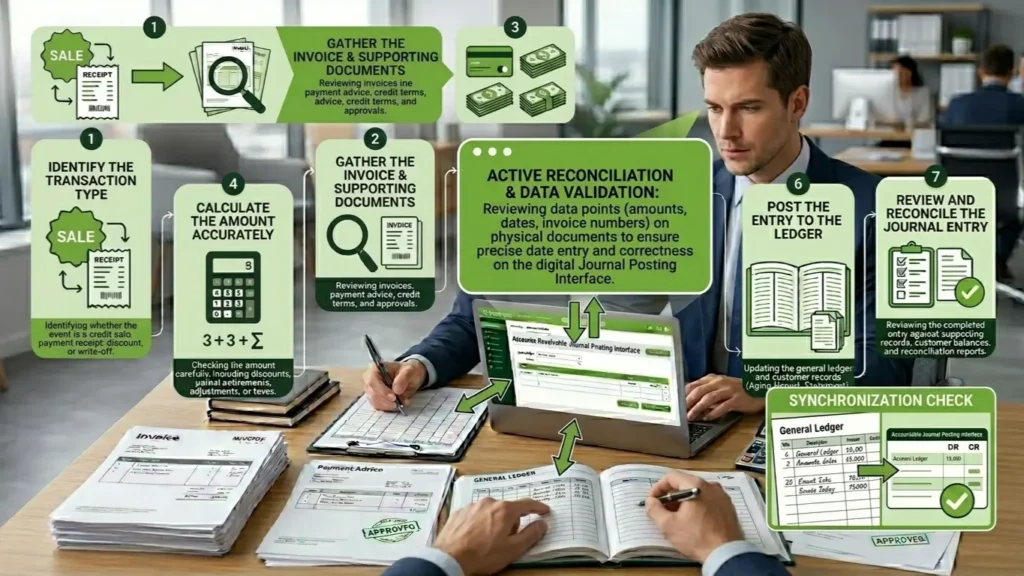
The 7 key steps in creating an accounts receivable journal entry help businesses record customer transactions consistently, reduce posting errors, strengthen internal controls, and support accurate reporting across the accounting cycle.
Step 1: Identify the transaction type
The first step is identifying whether the event is a credit sale, payment receipt, discount, adjustment, or write-off, because each transaction requires a different accounting treatment.
Step 2: Gather the invoice and supporting documents
The second step is reviewing invoices, payment advice, credit terms, and approvals so the entry is supported by verifiable business records and the amount can be justified.
Step 3: Determine the accounts involved
The third step is identifying which accounts will be affected, such as accounts receivable, revenue, cash, sales discount, or bad debt expense.
Step 4: Calculate the amount accurately
The fourth step is checking the amount carefully, including discounts, partial settlements, adjustments, or taxes, so the entry reflects the real transaction and reporting period.
Step 5: Record the debit and credit correctly
The fifth step is posting the debit and credit accurately in line with double-entry accounting, ensuring the receivable increases or decreases in the right direction.
Step 6: Post the Accounts Receivable General Journal Entry to the Ledger
The sixth step is posting the accounts receivable general journal entry to the general ledger and updating the relevant customer record so the trial balance, aging report, and customer statement remain aligned.
A properly prepared accounts receivable general journal entry should include the transaction date, affected accounts, debit and credit amounts, and a clear reference to the supporting invoice or payment document.
Step 7: Review and reconcile the journal entry
The seventh step is reviewing the completed entry against supporting records, customer balances, and reconciliation reports to detect errors before they affect reporting or collections.
Why a step-by-step accounts receivable journal entry process reduces accounting errors
A step-by-step accounts receivable journal entry process reduces accounting errors because it creates consistency, improves documentation, and makes it easier for finance teams to spot missing details, misclassifications, and timing mistakes.
What Common Mistakes Should Businesses Avoid in Accounts Receivable Entries?
Common mistakes in accounts receivable entries include wrong dates, incorrect amounts, missing support documents, and poor classification, all of which can weaken compliance, distort financial statements, and delay collections.
Misclassifying revenue and receivables
Misclassifying revenue and receivables creates reporting problems because the business may recognise income incorrectly or overstate customer balances in the accounting records.
Using incorrect dates or amounts
Using incorrect dates or amounts can place entries in the wrong reporting period, affecting monthly management reports, aging analysis, and tax-related accounting accuracy.
Ignoring discounts, adjustments, or write-offs
Ignoring discounts, adjustments, or write-offs leaves customer balances inaccurate and can cause reconciliation issues, collection confusion, and unreliable year-end financial statements.
What Are the Best Practices for Managing Accounts Receivable Efficiently?

Best practices for managing accounts receivable efficiently include disciplined invoicing, regular reconciliation, aging review, and professional oversight, all of which improve collection speed and strengthen financial reporting quality.
Use clear invoicing and credit control procedures
Clear invoicing and credit control procedures improve receivables management by reducing disputes, making payment terms visible, and encouraging customers to pay within the agreed timeframe.
Monitor aging reports and overdue balances
Aging reports help businesses prioritise collection activity by showing which invoices are current, overdue, or high risk, allowing faster follow-up and more practical cash flow planning.
Strengthen internal controls and documentation
Strong internal controls and documentation support accurate journal entries, reliable audit trails, and smoother review processes for management, external accountants, and advisory teams.
For businesses handling larger transaction volumes or facing process weaknesses, structured accounting support can help standardise receivables workflows and improve reporting confidence through Accounting Insights & Advisory and stronger support from an accounting firm.
Creating an accounts receivable journal entry accurately requires more than basic debit-and-credit knowledge.
Businesses need a clear process, reliable supporting documents, and regular review to ensure that credit sales, collections, discounts, and write-offs are recorded properly.
When receivables are managed well, financial reporting becomes more reliable, cash flow planning improves, and management can make decisions with greater confidence.
If your business wants stronger receivables control, clearer reporting, and more reliable accounting processes, professional support can make a measurable difference.
Procheck helps businesses improve transaction accuracy, internal controls, and financial record management through practical Accounting Services.
This is especially useful for SMEs, startups, and growing organisations that need accounting guidance without weakening compliance or reporting quality.
FAQ
How do I set up an efficient accounts receivable system for a small business?
An efficient receivables system should include clear payment terms, timely invoicing, accurate customer records, regular aging reviews, and consistent follow-up on overdue balances.
Businesses should also reconcile receivables regularly to ensure the ledger matches actual customer balances.
How can a small business automate accounts receivable processes?
A small business can automate invoicing, payment reminders, customer statements, aging reports, and payment tracking through accounting software.
Automation can reduce manual work, but finance teams should still review exceptions and reconcile balances regularly.
What are the key metrics to track for accounts receivable performance?
Important metrics include Days Sales Outstanding, accounts receivable turnover, average collection period, overdue invoice percentage, and balances outstanding for more than 90 days. These metrics help businesses monitor collection efficiency and cash flow risk.
What are common reasons for accounts receivable write-offs and how can they be minimized?
Common causes include customer insolvency, payment disputes, weak credit checks, poor follow-up, and long-overdue invoices. Businesses can reduce write-offs by applying clear credit policies, reviewing aging reports, documenting collection activity, and following up early.
What are the best practices for sending professional payment reminder emails?
Payment reminders should be polite, clear, and specific. Include the invoice number, outstanding amount, due date, payment instructions, and contact details. Follow a consistent reminder schedule and keep records of all communication for future reference.