
The e-invoice implementation date in Malaysia depends on annual business turnover, LHDN implementation phases and exemption criteria.
Businesses should check whether they fall under the 2024, 2025, 2026 or concessionary timeline before preparing their accounting system, invoicing process and compliance workflow.
Key Takeaways
- The e-invoice implementation date in Malaysia is based mainly on annual turnover or revenue.
- Businesses with turnover above RM25 million up to RM100 million started on 1 January 2025.
- Businesses with turnover above RM5 million up to RM25 million started on 1 July 2025.
- Businesses with turnover up to RM5 million fall under the 1 January 2026 phase.
- Taxpayers with annual turnover or revenue below RM1 million may be exempted from e-Invoice implementation, subject to LHDN criteria.
- Some businesses may need to refer to the 1 July 2026 concessionary e-Invoice implementation date if they do not qualify for exemption or fall under specific LHDN FAQ conditions.
E-invoicing is more than just a compliance requirement—it is part of Malaysia’s digital tax transformation strategy aimed at strengthening transparency, reducing fraud, and streamlining reporting.
For businesses, this means shifting from manual or semi-automated invoicing systems to structured electronic formats that integrate with LHDN’s platform.
The implications are significant, impacting cash flow management, tax audits, and long-term business efficiency.
Procheck Faculty Sdn Bhd, a 100% Bumiputera-owned firm with over 25 years of experience in taxation, assurance, corporate services, and advisory, plays a crucial role in helping businesses navigate this transition.
Their expertise ensures that SMEs, multinational corporations, and entrepreneurs alike are not only compliant but also strategically positioned to benefit from digital invoicing.
“Provide service account, tax, audit, company secretary.”
Hans Empire, ★★★★★
“Perkhidmatan Setiausaha Syarikat dari Procheck sangat profesional dan cekap. Mereka membantu saya menguruskan dokumentasi syarikat dengan teliti dan memastikan pematuhan undang-undang. Terima kasih kepada pasukan Procheck yang sangat berdedikasi!”
Noor Ariffshah, ★★★★★
These endorsements highlight Procheck’s commitment to ensuring that businesses, regardless of size or industry, receive practical and dependable guidance in managing regulatory changes like e-invoicing.
As each implementation phase approaches, understanding the correct e-invoice implementation date, exemption criteria, concessionary timeline and compliance strategy is essential for every business.
This article explains the latest LHDN timeline, e invoice start date, exemption rules and preparation steps while showing how Procheck can support businesses during the transition.
Simplify Your Tax Management Today!
Partner with Procheck today to unlock your business’s full potential. Our team of experts is ready to help you navigate taxation challenges and achieve your strategic goals.
Request a Free Consultation
Get started with a no-obligation consultation to discover how we can transform your financial operations.
What Is the E-Invoice Implementation Date and Why Does It Matter?
The e-invoice implementation date refers to the official LHDN timeline for when businesses must start using electronic invoicing based on their annual turnover, exemption status and implementation phase.
This shift is significant because it affects SMEs, larger corporations, startups and related companies differently. Each business must confirm its own e invoice start date instead of assuming that one deadline applies to every taxpayer.
- It matters because e-invoicing will:
- Enhance tax transparency
- Reduce fraud and leakages
- Streamline reporting and audits
- Support Malaysia’s digital economy goals
- Enhance tax transparency
Phased Roll-Out: What Are the Implementation Dates by Annual Turnover Threshold?
The e-invoice roll-out is structured by annual revenue, with larger corporations adopting e-Invoice earlier while smaller businesses follow later phases or check whether they qualify for exemption.
How Large Corporations Are Affected by the Early Start Date
Businesses with revenue above RM100 million began e-invoicing in August 2024. These corporations act as early adopters, ensuring the system works at scale.
When SMEs Need to Check Their E Invoice Start Date
SMEs with turnover up to RM5 million generally fall under the 1 January 2026 phase. However, businesses below RM1 million should check whether they qualify for exemption instead of assuming that 1 July 2026 is their automatic e invoice start date.
Which Entities Are Covered Under Each Threshold
- More than RM100 million: 1 August 2024
- More than RM25 million up to RM100 million: 1 January 2025
- More than RM5 million up to RM25 million: 1 July 2025
- Up to RM5 million: 1 January 2026
- Less than RM1 million: Exempted from e-Invoice implementation, subject to LHDN criteria
- Certain concessionary cases: 1 July 2026, depending on LHDN FAQ conditions
The e invoicing implementation timeline should always be checked against the latest LHDN guidance because exemption status, concessionary treatment and business category can affect the actual date that applies to a company.
What Do the Guidelines and FAQs from LHDN Confirm?
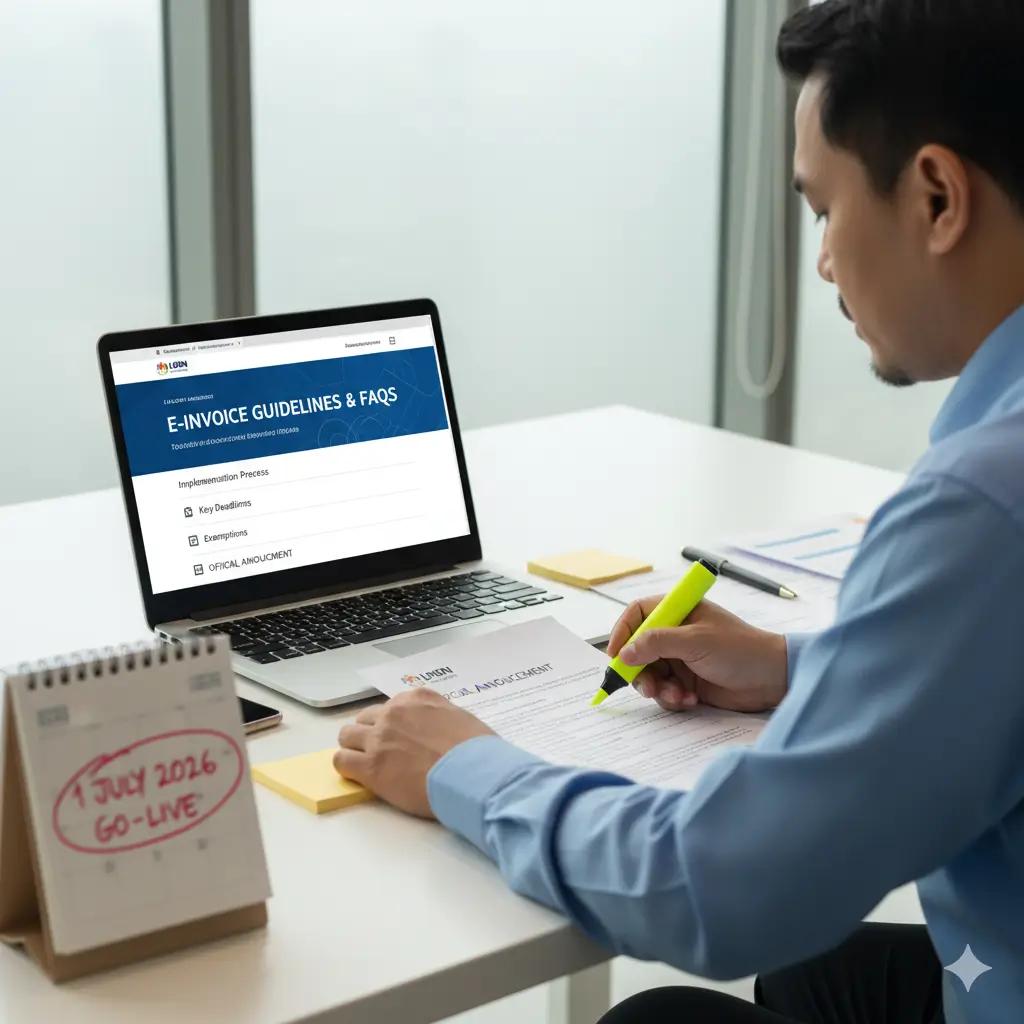
LHDN’s published guidelines and general FAQs clarify the einvoice implementation process, implementation phases, concessionary treatment and exemption rules for different taxpayer categories.
Where to Access Official LHDN Announcements
All official updates should be checked through the LHDN website, especially the official e-Invoice implementation timeline, general FAQ and specific guideline documents. This helps businesses avoid relying on outdated summaries or social media claims.
How LHDN FAQs Clarify the E-Invoice Implementation Date
The FAQs help businesses understand whether they fall under a mandatory phase, exemption category or concessionary timeline. This is important because the e-invoice implementation date may differ depending on turnover, year of assessment and LHDN criteria.
How Does the Relaxation (Grace) Period Work After Each Phase?
LHDN has provided relaxation treatment for certain implementation phases, allowing affected businesses time to adjust their systems, processes and documentation before full enforcement applies.
Why the Relaxation Period Is Critical for Businesses
This buffer helps affected businesses test accounting systems, prepare staff, check customer and supplier data, and improve internal invoicing workflows before stricter compliance enforcement begins.
What Flexibilities Are Permitted During the Grace Period
During relaxation periods, affected businesses may be allowed to use certain transitional approaches, such as consolidated e-Invoices, depending on LHDN’s latest guidance. However, they should still work toward full compliance instead of delaying preparation.
MSMEs and Exemption Rules: Who Is Exempt and Why?
Not every taxpayer follows the same e-invoice implementation date because LHDN provides exemption treatment for certain categories, especially taxpayers below the required annual turnover or revenue threshold.
Which Turnover Threshold May Qualify for Exemption
Taxpayers with annual turnover or revenue below RM1 million may be exempted from e-Invoice implementation, subject to LHDN criteria. However, some businesses may still adopt e-Invoice voluntarily for better recordkeeping, customer documentation and accounting efficiency.
How Exemptions Apply to Specific Taxpayer Categories
Exemption status depends on the taxpayer category, annual turnover or revenue, year of assessment and the latest LHDN guidance. Businesses should avoid assuming that one final e invoicing implementation date applies to every company.
Special Cases: How Are New Businesses, Related Companies, and Revenue Thresholds Managed?
Special rules may apply to new businesses, related companies and taxpayers whose turnover reaches the relevant threshold in different years of assessment.
When New Companies Need to Check Their E-Invoice Timeline
New companies should check their e-Invoice timeline based on their commencement date, annual turnover or revenue, year of assessment and any concessionary treatment stated in the latest LHDN FAQ.
How Related Companies Are Treated Under the Rules
Related companies, subsidiaries or entities under a wider group should review whether the group structure affects their implementation phase. In some cases, the relevant e-invoice implementation date may depend on group-level treatment, turnover threshold or specific LHDN guidance.
Penalties & Enforcement: When Will LHDN Begin Sanctions?
Businesses that fall under a mandatory e-Invoice phase should prepare before their applicable deadline because LHDN may enforce penalties when taxpayers fail to comply with required obligations.
What Types of Penalties Are Involved
Failure to comply with e-Invoice requirements may expose businesses to financial penalties, audit risk, documentation issues and possible tax compliance complications, depending on the nature of non-compliance.
Businesses managing supplier payments should also understand related tax obligations such as withholding tax in Malaysia, especially when dealing with payments to non-residents.
How Businesses Can Avoid Non-Compliance
Businesses can reduce non-compliance risk by checking their correct implementation phase, reviewing accounting software, preparing complete invoice data, training staff and getting professional guidance before the e-invoice implementation date becomes urgent.
Recent Changes to the Guidelines: What Updates from 2025 Mean for Businesses?

LHDN’s 2025 updates and FAQ clarifications helped businesses better understand implementation phases, exemption treatment, concessionary timelines and preparation requirements.
Why the 2025 Guideline Updates Are Important
The updates are important because businesses must distinguish between mandatory phases, exemption status and concessionary dates. Without this distinction, companies may misunderstand which e-invoice implementation date applies to them.
Which Key Revisions SMEs and Corporates Must Note
- Clarified exemption treatment for taxpayers below RM1 million turnover
- Explained concessionary cases that may refer to 1 July 2026
- Expanded FAQ support for businesses checking their implementation phase
- Highlighted the need to confirm turnover, year of assessment and taxpayer category
How Can Procheck Support Businesses During the E-Invoice Transition?
With over 25 years of experience, Procheck Faculty Sdn Bhd helps businesses review their tax position, accounting records and internal process before e-Invoice compliance becomes urgent.
What Tax Services Are Relevant to E-Invoice Compliance
Procheck’s Tax Services can help businesses review their implementation phase, invoice documentation, tax reporting process and readiness before the relevant e-invoice implementation date applies.
How Advisory and Business Consulting Services Add Value
Advisory and business consulting support can help companies improve invoicing workflows, identify process gaps, prepare staff and choose a practical approach for e-Invoice adoption.
Why Professional Corporate Services Improve Compliance Confidence
Corporate services, company secretarial support and financial reviews can help businesses maintain proper records, improve documentation quality and reduce compliance confusion during the e-Invoice transition.
The e-invoice implementation date is not the same for every business in Malaysia. It depends on annual turnover, LHDN implementation phase, exemption criteria and whether the taxpayer falls under a concessionary timeline.
Preparing for e-Invoice does not have to be overwhelming when businesses understand their correct timeline early. Procheck Faculty Sdn Bhd helps businesses review tax readiness, accounting records and documentation before e-Invoice compliance becomes urgent.
Whether you are an SME, larger company or entrepreneur, Procheck’s Tax Services and income taxes insights can help you understand your obligations, avoid outdated assumptions and prepare for Malaysia’s digital tax era.
Take the proactive step today—get professional guidance before your applicable e-invoice implementation date becomes urgent.
Frequently Asked Questions About E-Invoice Implementation Date
What is the e-invoice implementation date in Malaysia?
The e-invoice implementation date in Malaysia depends on annual turnover or revenue. The main LHDN phases include 1 August 2024, 1 January 2025, 1 July 2025 and 1 January 2026, while some taxpayers must also review exemption and concessionary rules.
What is the e invoice start date for SMEs?
The e invoice start date for many SMEs depends on their turnover category. Businesses with turnover up to RM5 million generally fall under the 1 January 2026 phase, while taxpayers below RM1 million may be exempted if they meet LHDN criteria.
Is e-Invoice mandatory for businesses below RM1 million?
Taxpayers with annual turnover or revenue below RM1 million may be exempted from e-Invoice implementation, subject to LHDN criteria. However, businesses that do not meet exemption conditions may need to follow a concessionary implementation timeline.
What is the 1 July 2026 e-Invoice date?
The 1 July 2026 date is a concessionary or special-case e-Invoice date for certain taxpayers. It may apply when a taxpayer reaches or exceeds RM1 million in YA2023, YA2024 or YA2025, or when the taxpayer does not meet exemption conditions.
How does the relaxation period work after the e invoice start date?
LHDN may provide relaxation treatment for affected implementation phases. During this period, businesses should test accounting systems, prepare staff, check invoice data and move toward full compliance based on the latest LHDN guidance.
How can businesses prepare before e-Invoice implementation?
Businesses should confirm their turnover category, review exemption status, update accounting records, check accounting software readiness, prepare customer and supplier data, and train staff before the relevant implementation date.
How can Procheck help businesses with e-Invoice compliance?
Procheck can help businesses review their implementation phase, accounting documentation, tax readiness and internal process before e-Invoice compliance becomes urgent.